Crack or Fissure? What’s the Difference?
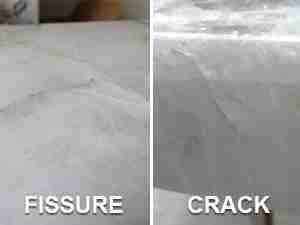
Fabricators and restoration contractors often get calls about cracks in natural stone countertops. Sometimes these “cracks” are not cracks at all, but fissures, a feature of the stone that resembles a crack. How does one go about determining whether a countertop has a fissure or a crack? It all boils down to observation.
Naturally Occurring Versus Human Intervention
Fissures are a result of naturally occurring phenomenon, such as geological and environmental forces, crystallization of minerals, and other conditions. Cracks are a result of man-made stresses, such as transport from the quarry to the fabricator or from fabricator to a residence or commercial facility. Man-made stresses may also happen during the installation process.
Visual Differences
Knowing what to look for can help with determining whether you are dealing with a fissure or a crack. Fissures are elongated but extremely narrow openings along the boundaries of crystalline structures in the stone. The visible separation usually remains within the depth of the stone, although it sometimes can go entirely through. Fissures often appear in more than one place on the slab and are rarely straight. Cracks can be narrow or wide, usually only appear in one place on the slab, and may go through the entire depth of the stone. Cracks caused by stresses during the installation process are commonly observed in straight lines near supporting structures.
Tactile Differences
Knowing how a crack or fissure feels when you run your fingernail across the surface of the stone can help you determine whether you are dealing with a fissure or a crack. Your fingernail will run smoothly over a fissure, because a fissure does not change the plane of the stone, and it does not cause any gaps or depressions in the stone. However, your fingernail will not run smoothly over a crack. There will be noticeable unevenness, as one side of the crack is often higher than the other side. In other words, a crack can change the plane of the stone, and your fingernail will catch on the difference.
From Fissure to Crack
A fissure is not a crack, and although fissures rarely affect the soundness of the stone, sometimes a fissure can develop into a crack. You will know if this happens because there will be some chipping, separation, and obvious breakage.
What To Do About Fissures and Cracks
Fissures are naturally occurring and add to the character of stone slab. As such, nothing at all should be done about them. Some people who purchase quartz, onyx, or other translucent stones under-light them to bring attention to fissures and other natural features. Cracks, on the other hand, are structural defects that can worsen over time and may harbor bacteria and contaminants. Cracks should be repaired by a trained and qualified stone restoration contractor who can determine whether underlying structural repairs are needed and match the repair site as closely as possible with the surrounding stone.
We handle every type of job so if you’re unsure what service you need just give us a call as we’d be happy to help you or you can fill out our simple contact form and someone will reach out to you promptly.
Bayshore Cleaning & Restoration – Proudly Serving Hillsborough, Pinellas and Pasco Counties